For the past 10 years since it was established, the University of Guam’s (UOG) School of Engineering has been operating on three separate sites. Engineering students held classes in other colleges. An old private facility off-campus hosted the dean’s office and the faculty staff. The engineering labs were located in one of the small bungalows in the Dean’s Circle designated for UOG’s non-academic grant programs and other affiliated entities.
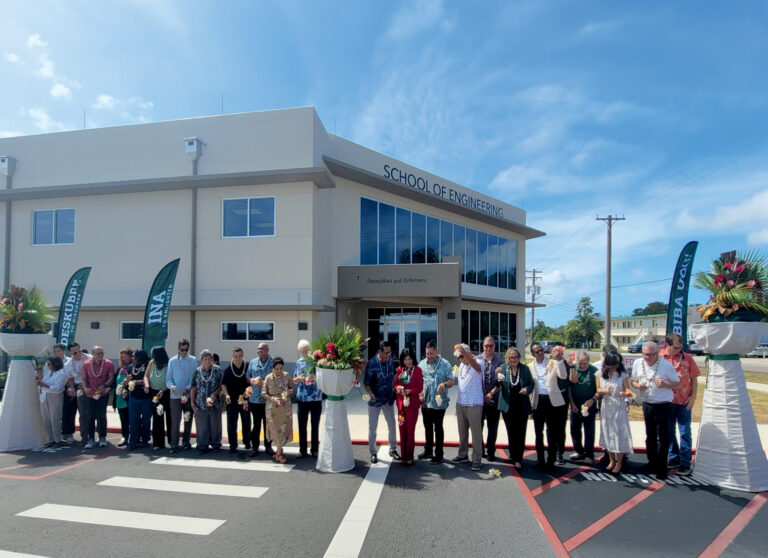
On Jan. 16, the nomadic status of the School of Engineering’s faculty and 300 students ended when UOG officials cut the ribbon for an $8-million brand-new building on the Mangilao campus. University officials described the project’s completion as “a transformative step for engineering education on Guam and Micronesia.”

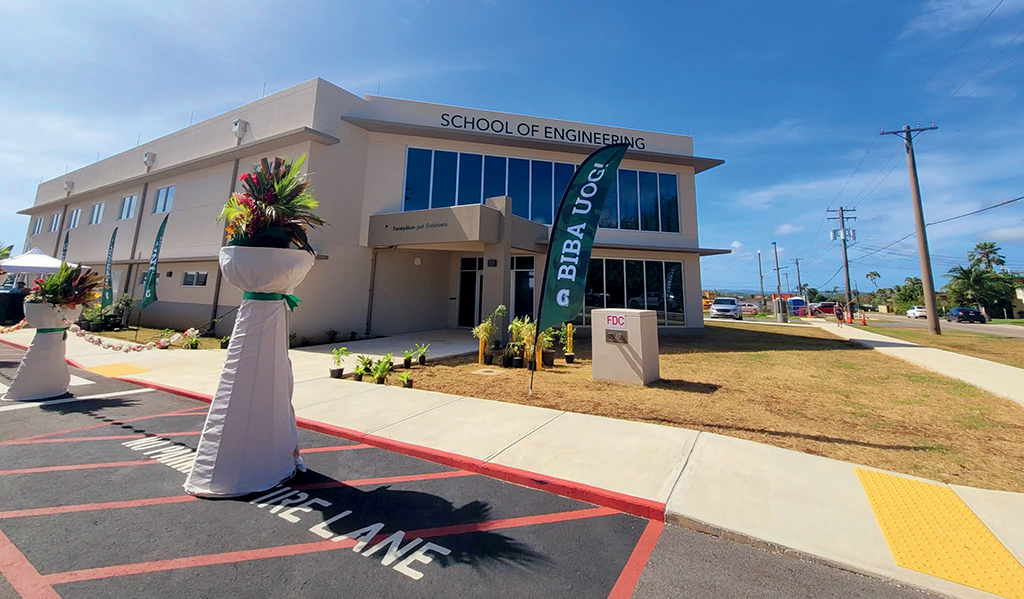
For Dr. Hiroshan Heterriarachi, dean of the School of Engineering, the opening of the 16,000-square-foot facility “means pretty much everything.” Consolidating the school’s operations in one location, he says, promises to bring the program’s performance level up another notch. “This represents the future of engineering on the island,” says Heterriarachi, a civil engineer by training.
The School of Engineering offers a four-year Bachelor of Science in Civil Engineering, which has earned a six-year accreditation from the Accreditation Board of Engineering and Technology (ABET). “We did so many amazing things without even having a building,” Heterriarachi says. “So now you can understand where we can go with a building because all operations will be here. We have a place to show this is an icon.”
Designed and built by Future World, the School of Engineering building was funded with a grant secured by UOG’s Endowment Foundation from the U.S. Department of Agriculture’s Rural Development Program. The facility includes classrooms, conference and meeting spaces, faculty offices and modern laboratories equipped with a host of cutting-edge engineering equipment. Construction began in December 2023.
“The building costs $8 million, excluding the furniture and lab equipment. We actually have to find another $2 million,” Heterriarachi says.
27 Years in the Making
The establishment of the School of Engineering began 27 years ago as part of UOG’s long-held vision to produce homegrown engineers amid the island’s construction boom. In 1989, UOG introduced a pre-engineering program to fill the chronic need for local engineers for Guam and the other islands in the Western Pacific.

“The program produced students prepared for admission as juniors into any four-year engineering school accredited by ABET,” says Dr. Anita Borja Enriquez, UOG president.
UOG later partnered with University of Iowa’s College of Engineering and Mapua Institute of Technology in the Philippines, providing avenues for pre-engineering students to complete their engineering degrees. On Oct. 29, 2009, Dr. Robert Underwood, then president of UOG, proposed upgrading the program into a four-year accredited engineering degree course to help meet the growing demand for engineering expertise in the region’s private and public sectors.
“During his tenure, Dr. Underwood — with support from all industry partners — was instrumental in raising initial capital funds to support our planned new buildings, including the School of Engineering,” Enriquez says.
The UOG Board of Regents formally established the School of Engineering in September 2016 and approved a four-year bachelor of science degree in civil engineering, which was accredited by ABET in September 2024.
Enriquez says the program’s accreditation — obtained on first attempt — affirmed that it meets the global standard for technical education in engineering. The accreditation paved the way for partnerships with the U.S. Naval Facilities Engineering Systems Command, the Guam Power Authority and private engineering firms, facilitating summer internships and employment for engineering graduates. “But we still needed a permanent home,” Enriquez says.
The construction of the School of Engineering building was “part of the mid-decade journey of collaboration and perseverance, with multiple challenges over a 10-year period, including the Covid-19 global pandemic, typhoons, legal matters with maps, leases and property divisions, increasing cost of construction and supplies, finding bridge funding and so forth,” Enriquez says. “Getting to this exact moment was a long, arduous process with many partners and many steps.”
Greater Things to Come
Over the past four years, the School of Engineering has graduated 62 students. “You have to understand this is a new program. Every new program undergoes fluctuations in the beginning,” Heterriarachi says. “Some semesters we have few, some semesters we have too many. For an example, last semester we graduated 30 — that’s a lot. In the future, my hunch is that there will be like steady [numbers] between 15 to 20 every year.”
The School of Engineering has just established its second program: Bachelor of Science in Construction Management and it’s set to recruit students this fall. A new Bachelor of Science in Electrical Engineering will follow in the fall of 2027.
“It all depends on the kind of experience you’re looking for. Those interested in mechanical engineering can follow the 2+2 pathways program we have established with University of Hawai‘i at Mānoa and the Colorado School of Mines,” Heterriarachi says. “The 2+2 program is something we do when we do not offer that branch of engineering.”
The School of Engineering currently does not offer a mechanical engineering program and does not have plans to make it available in the near future. “So we teamed up with the University of Hawai‘i at Mānoa campus. It’s a pathway our students can take. They go to school here for two years, [then] they go there for another two years. And now we have another option through Colorado School of Mines,” Heterriarachi says.
The Colorado School of Mines, which now has a satellite campus at UOG, focuses on additive manufacturing in preparation for the development of the 3D printing industry on Guam. The University of Hawai‘i at Mānoa’s College of Engineering focuses more on the shipyards. “So both are in a way related to the military, naval activities, but two different branches,” says Heterriarachi.
Encouraging students to enroll would have been a challenge. “When you don’t have a brand, it’s kind of difficult without a fan base. Some students and some parents decided to take the chance and come here. That helped us,” Heterriarachi says. “So we need that kind of support in the future too.”
The School of Engineering will need bigger space in the future, Heterriarachi says, noting that the new building is barely enough to handle the civil engineering program. “We have all our labs for civil engineering downstairs. We have teaching space and faculty and administrative offices upstairs; that’s it,” he says. “The good thing is we have a building now and we can start planning our future expansion from here.”