
Concrete and Cement Take Flight
Superior products and steady pricing lift 2025-2026 projects statewide
The Runway 8L project at Daniel K. Inouye International Airport contains 
more than 43,000 cubic yards of portland cement concrete. PHOTO COURTESY ORION ENGINEERS & ASSOCIATES

Concrete may be rock-solid, but it and other cementitious building products are proving to be remarkably buoyant in 2025.

For instance, Dragados/Hawaiian Dredging/Orion Joint Venture (DHOJV) will soon float 4,000-ton concrete panels deep beneath the surface of Pearl Harbor as part of the build-out of Dry Dock 5.

And much to the relief of DHOJV and other Hawai‘i builders, tariffs are not yet slowing down their supply of concrete and cement.

The Dragados/Hawaiian Dredging/Orion Joint Venture crew prepares to load the 4,000-ton precast floor units for 
transport across Pearl Harbor to the 
Dry Dock 5 job site. PHOTO COURTESY Dragados/Hawaiian Dredging/Orion Joint Venture
Kirk Hashimoto
Cassie Idehara

Hawai‘i’s Stable Market

According to local experts, the current supply of concrete and cement is meeting Hawai‘i demand so far.

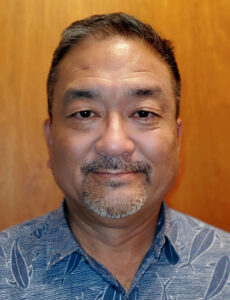
“Demand has started off slowly this year but is expected to remain somewhat steady as compared to last year,” says Kirk S. Hashimoto, Cement and Concrete Products Industry (CCPI) of Hawaii executive director.

Local pricing may be a stabilizing factor.

Cassie Idehara, Rider Levett Bucknall vice president overseeing the firm’s cost consultancy practice in the Hawai‘i region, says “while international trade developments have introduced minor cost pressures, the overall impact on Hawai‘i’s cement and concrete supply remains minimal.

“For example, Rider Levett Bucknall has received notice from a local supplier indicating a cost increase of $1.50 per cubic yard for ready-mix concrete pricing due to tariffs,” Idehara says. “Given that the price for ready-mix concrete is approximately $350 per cubic yard, this adjustment represents a negligible change.”

Still, local suppliers are taking steps to ensure supply resilience, she says: “While Taiwan has been cited as a reliable source, and recent trends indicate increased imports from Vietnam, Rider Levett Bucknall is aware that Hawai‘i-based suppliers have explored additional sourcing opportunities in Thailand.”

Performance Profile:
PORTLAND CEMENT CONCRETE

The quality of the portland cement concrete used at Daniel K. Inouye International Airport’s Runway 8L has proven to be essential to the success of the project.      PHOTO COURTESY ORION ENGINEERS & ASSOCIATES

Orion Engineers & Associates, a Hawai‘i civil engineering firm specializing in designing airfields, designed, developed and managed critical aspects of the Daniel K. Inouye International Airport’s recent Runway 8L Expansion project.

The work was executed within a scheduled partial closure, during which areas of the runway remained operational.

Descriptive alt text

Shannon Holman

Shannon Holman, Orion president and professional engineer, says more than 43,000 cubic yards of portland cement concrete (PCC) was placed at the project. The PCC was concentrated at the 8L approach end, covering the first 2,000 feet of runway, including a portion of Taxiway A.

“Quality was essential — both from a structural and operational standpoint,” Holman says. “The approach end of Runway 8L is subject not only to landing loads from arriving widebody aircraft but also to sustained, slow-moving gear loads from aircraft crossing or turning onto the runway via Taxiway A.”

PCC, meeting Federal Aviation Administration P-501 standards, provided the performance needed to resist cracking, rutting and early degradation, she says.

The contractor conducted multiple trial [PCC] batches to develop a slip-form paving mix that met FAA P-501 performance criteria while adapting to local materials and climate. The final mix design included gap-graded aggregates, fly ash and admixtures to control air content and improve workability. To meet sustainability goals, demolished concrete from the existing runway was used as base material for shoulder pavement.

Construction was completed in December 2023.

“The project team views the successful integration of PCC paving during a partial runway closure as a major engineering win,” Holman says. “Executing full-depth PCC pavement under active airfield conditions required a high level of contractor readiness and stakeholder coordination and trust. The HNL Runway 8L Widening Project exemplifies how technical excellence and sustainable construction can coexist, even in the most operationally demanding environments.”
Roy Morioka

Rising Demand for Ready-Mix

No matter its origin, concrete’s elasticity and durability make it the first and only choice on many leading Hawai‘i projects.

Hawaiian Cement, HC&D LLC and Island Ready-Mix Concrete Inc. are the local companies providing concrete and/or cement for Dry Dock 5 at Pearl Harbor, the U.S. Navy’s highest-value single project in its history, says DHOJV Project Manager Roy Morioka. (The project’s official Navy title is “FY23 MCON Project P-209, Dry Dock 3 Replacement.”)

Approximately 65,000 cubic yards are needed for the dry dock walls and mechanical galleries, around 13,000 cubic yards for the nine precast floor units (PFUs) and 60,000 cubic yards to create the rest of the floor slab. The dry dock’s steel caisson gate includes about 400 cubic yards of ready-mix concrete to serve as a ballast weight.

“The ready-mix concrete used for the precast floor units is produced by Hawaiian Cement at their Hālawa batch plant,” Morioka says. “The ready-mix concrete used for the dry dock walls and floor will be produced with a temporary on-site batch plant and the rest of the concrete … is being produced by local ready-mix companies on O‘ahu.”

The nine PFUs are being fabricated at Waipio Peninsula across the harbor from the dry dock job site. Morioka says the PFUs will be transported there individually by a semi-submersible barge, floated off the barge deck in water more than 60 feet deep and lowered into final position inside the dry dock.

Kevin O’Connell  

Precast Gains Traction

GPRM Prestress LLC, which manufactures a wide range of concrete double-tees, slabs, planks, beams, walls and other precast elements at its Kapolei facility, is currently working on Dry Dock 5.

GPRM is also responding to “continued demand for all-precast warehouses and housing,” says Kevin O’Connell, the company’s sales manager.

Federal work continues to see high precast demand, O’Connell reports, with many precast additions and new structures also going up for the Hawai‘i State Department of Education. “Benefits are speed of construction, durability, fire resistance and design assistance to get through and complete the design documents, and constructability with the design team,” he says.

At Kalana O Maui, Phase 2 concrete restoration, railing and waterproofing is underway by Structural Concrete.  
PHOTO COURTESY STRUCTURAL CONCRETE BONDING & RESTORATION INC.

The company’s current projects include the dry dock and two other federal projects: the Aviation Unit Operations Building at Wheeler Army Airfield and the Hawai‘i Army National Guard Readiness Center Addition. Current education work encompasses Farrington and Waipahu high schools, August Ahrens Elementary School and a Lāhainā campus. Affordable housing includes the Algaroba and 1568 Pensacola Street projects. And GPRM has two big West O‘ahu warehouses underway — Kapolei Crossing and ODEX Kapolei.

With business booming, O’Connell says GPRM is introducing new products and services: polished concrete, high-end formwork for exterior facades and the design and construction of insulated panels.

At Kalana O Maui, Phase 2 concrete restoration, railing and waterproofing is underway by Structural Concrete.      PHOTO COURTESY STRUCTURAL CONCRETE BONDING & RESTORATION INC.
Tracy Tominc

Digging In on Maui

According to Tracy Tominc, Construction Industry of Maui board member and president of a Maui building firm, there’s no end in sight for concrete repair and restoration work on the Valley Isle.

“With concrete being a leading material used in nearly all construction, in combination with the significant need for new and [rebuilt] housing following the Lāhainā devastation, concrete demand will increase in 2025-2026,” Tominc says.

Structural Concrete Bonding & Restoration Inc., Tominc’s company, offers its current lineup as proof: at least nine major projects, most in Maui’s hospitality and public works sectors.

These include major hotels, a County water tank, historic structures, seawalls island-wide and the renovation and repair of Maui’s War Memorial Football Stadium.

The company is also implementing concrete scanning services using Geographical Survey Systems Inc. technology as well as post-tension cable repair, replacement and external placement.

But Tominc is most excited about Structural Concrete’s on-grade post tension slabs.

“In lieu of conventional reinforced slabs, post-tension slabs reduce concrete construction costs by requiring 27-percent less concrete,” he says.

Related benefits — including a reduced carbon footprint and reduced rebar reinforcing and shipping requirements — “all equate to reduced construction costs and duration,” Tominc says.

Balancing the Mix

CCPI’s Hashimoto says Hawai‘i’s concrete industry leaders are pleased with current infrastructure improvements. But “if projects like the new [Aloha] stadium and the [Navy] projects continue on the projected schedules, we may see an increase in demand for concrete,” he cautions.

Likewise, Idehara says that while the impact of tariffs on Hawai‘i’s concrete construction market will remain minimal into 2026, the market may see additional cost pressure if construction increases.

Both Hashimoto and Idehara agree that, as he says, “one of the biggest challenges faced — as in many other industries — is staffing both in the blue-collar and white-collar sectors.”

Performance Profile:
MASONRY

Concrete masonry units provide structural strength, sustainability and a striking façade at Waipahu High School.      PHOTO COURTESY TILECO INC.

Hawai‘i’s demand for masonry products is increasing, say Keith Y. Kido, director of the Masonry Institute of Hawai‘i, and Leanne Ogata, president and COO of Tileco Inc., a local masonry manufacturer.

Descriptive alt text

Keith Kido

“Various types of natural-finished masonry have seen substantial growth the past five years due in part to the advancement of additives in manufacturing and placement,” says Kido.

As Hawai‘i works towards a greener future, “there is an increasing market for eco-friendly building materials,” Ogata says, adding that the inherent sustainability of concrete masonry units [CMU] — highly resilient, carbon-sequestering, recyclable, reusable, locally manufactured, longer building lifecycles, energy efficiency — continues to fuel high demand for Tileco standard-finish and ground-face CMU.

Descriptive alt text

Leanne Ogata

Ogata points to the Wahiawā Civic Center, an ongoing $76-million, 60,000-square-foot project that includes a two-story judicial building and a separate office building.

She says the project uses standard and architectural concrete masonry units that include several shades of ground-face block and multiple shades of split-face block from two Tileco product lines.

The project’s CMU are used “to produce an energy-efficient building envelope with a finished exterior façade,” Ogata says. “The superior strength and durability of CMU also … [have] the structural integrity to withstand higher wind and seismic force requirements required for this IBC Risk Category III building.”

Kido says the Masonry Institute in 2025-2026 is working to advance masonry’s role in Hawai‘i construction by actively participating “in building code review and revisions with industry organizations (AIA, SEAOH, BIA, MCAH, etc.) and state, county building officials … [to] educate [the] general public, design professionals, developers on the inherent sustainability of masonry.” For more information, go to masonryhawaii.com.
Related Images:

More articles