I
ncrement II of Kamehameha Schools’ (KS) Kaiāulu ‘o Kaka‘ako Master Plan (KKMP) is well underway with development of Blocks C, D, G, I and H, all of which have selected developers except Block H.
The latest update by KS as of this writing is the announcement of construction to support Hawaiian Electric Co. infrastructure beginning March 2026.
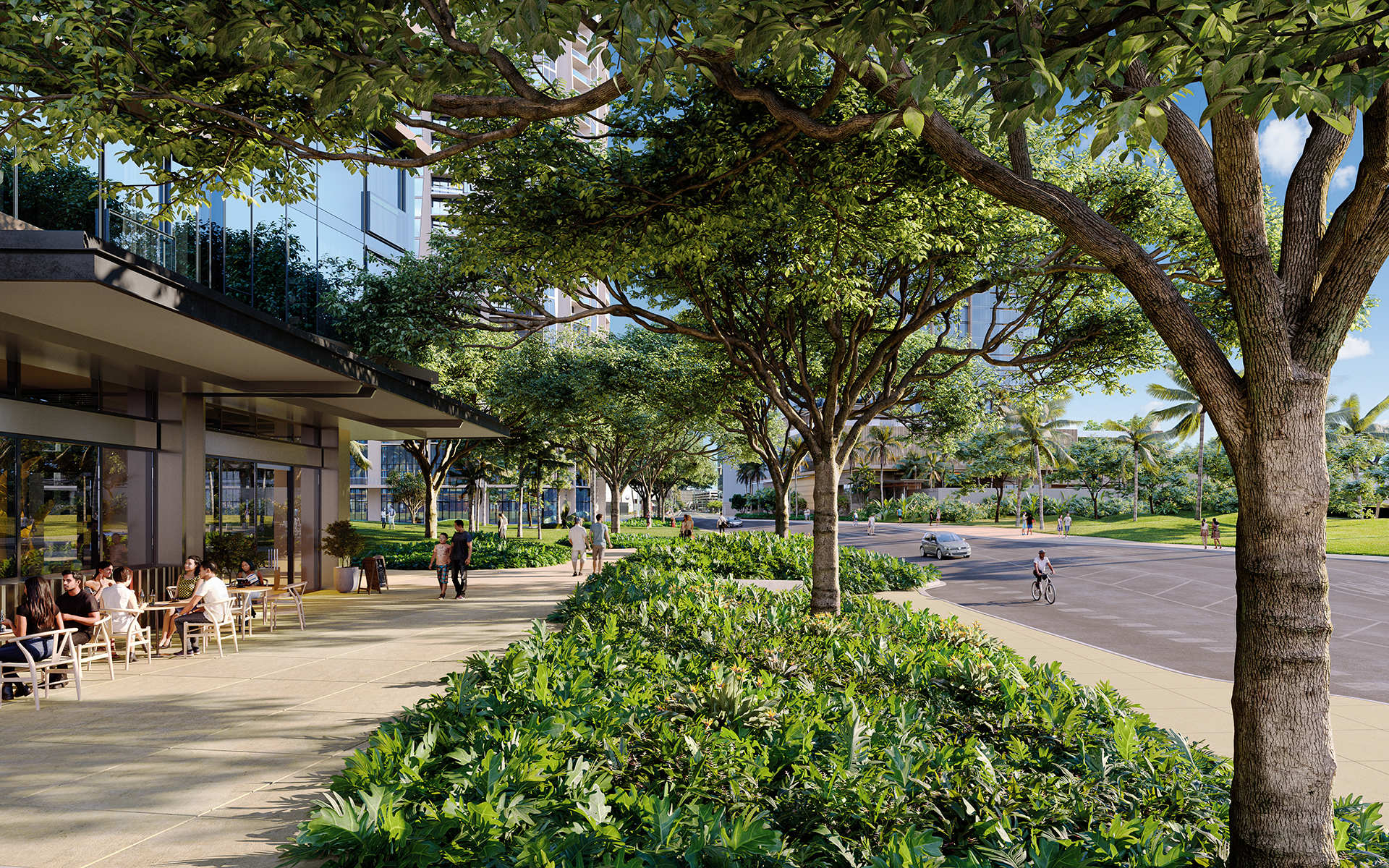
Developers and the Hawai‘i Community Development Authority (HCDA) reinforce that Increment II’s blocks will follow suit with the rest of Kaka‘ako’s design, aiming to create a walkable community to mirror the utilization of Honolulu’s urban core and waterfront.
New Century, New Designs
As the HCDA celebrates its 50th anniversary, the organization reflects on its “decades of planning, redevelopment and community building in the Kaka‘ako Community Development District,” says HCDA Executive Director Craig Nakamoto.
“[Lawmakers and the HCDA] … believed [Kaka‘ako] had potential for economic development with new commercial and industrial spaces, while providing public facilities, open space and an opportunity to develop vertical housing and help to prevent urban sprawl,” Nakamoto continues.
And that’s exactly what Kaka‘ako’s early designs demonstrate.
The first submittal by KS, called the Pauahi Place Master Plan (PPMP), in 1994 stated its intent to “create a pedestrian-oriented urban village designed to accommodate demand for office, residential, retail and light industrial space in Honolulu’s urban core in a manner that is both self-sustaining and integrated with activities on adjacent lands,” according to KS’ most current master plan, but was later abandoned due to “economic and non-economic factors” in 2005.
The termination of the PPMP also concurred with the release of the HCDA’s Mauka and Makai Area Rules, allowing KS to reimagine the area using the previously in-place Kaka‘ako Strategic Implementation Plan which later led to KKMP’s approval in 2009.
Howard Hughes was coincidingly developing Victoria Ward’s land under the Ward Village Master Plan, also approved by the HCDA in 2009.
“The scale and location of the Ward properties created an opportunity to transform these lands into a walkable, mixed-use neighborhood designed to bring new life and opportunity to the core of Honolulu while better serving residents, local businesses and the broader community,” says Doug Johnstone, Howard Hughes Communities Hawai‘i Region & National Condominium Development president.
Navigating Changes
Successful planning and execution of such a large-scale community requires flexibility, especially under its lengthy multiyear timeline.
“Over the past several decades, HCDA has had to address a range of evolving challenges, including infrastructure needs, housing affordability and changing market conditions,” says Nakamoto. “HCDA addressed a variety of issues, not unlike other agencies or developers, including community concerns, infrastructure capacity, balancing housing with open space, affordable housing requirements and legislative changes that may change redevelopment priorities.”
Affordable housing and employment demands were further pronounced by the COVID-19 pandemic, urging KS to amend KKMP in 2021 with support from the construction industry.

The termination of the PPMP also concurred with the release of the HCDA’s Mauka and Makai Area Rules, allowing KS to reimagine the area using the previously in-place Kaka‘ako Strategic Implementation Plan which later led to KKMP’s approval in 2009.
Howard Hughes was coincidingly developing Victoria Ward’s land under the Ward Village Master Plan, also approved by the HCDA in 2009.
“The scale and location of the Ward properties created an opportunity to transform these lands into a walkable, mixed-use neighborhood designed to bring new life and opportunity to the core of Honolulu while better serving residents, local businesses and the broader community,” says Doug Johnstone, Howard Hughes Communities Hawai‘i Region & National Condominium Development president.
Special Street Views
The connective intent of Kaka‘ako’s design doesn’t just involve street-level amenities; high-rises are also designed to foster community involvement.
Block C’s Kahuina, developed by Stanford Carr Development, exemplifies this concept through its design emphasis on ground-floor commercial space spanning 35,000 square feet between its two towers.
Keauhou Place, by the same developer, has 35 townhouses that line the parking structure to display “architecture at a much more humanistic scale, as opposed to a 400-foot high-rise next to a sidewalk,” says company president and founder Stanford Carr.
“Those are all intentional design elements in order to mitigate massing, but also to bring and activate the neighborhood,” he says. “When people are up in a high-rise, you’re kind of alienated, right?” However, Carr explains, when people are situated closer to ground level, they tend to discover and interact with their surroundings more.
Kahuina’s commercial spaces will also conceal its parking structure to further support walk-up business and neighborhood interaction.
“Infrastructure investments also improve how the neighborhood connects to the waterfront and nearby parks,” says Moore. “The elevated pedestrian bridge over Ala Moana Boulevard provides a grade-separated crossing that allows people to safely move between Ward Village, Kewalo Basin and Ala Moana Beach Park. By strengthening these connections, the neighborhood becomes more integrated with the surrounding Kaka‘ako community while expanding safe and convenient pedestrian access to the shoreline and public open space.”
Economic and Commercial Success
Kaka‘ako’s redevelopment had evidently benefitted O‘ahu since the beginning of its mainstream success.
“Today, Kaka‘ako looks dramatically different from the industrial district it once was. Public art and pedestrian pathways help connect neighborhoods to the waterfront. Residential towers now share space with restaurants, retail shops, parks and cultural venues,” says Nakamoto. “Redevelopment has had a significant economic impact. The state’s investment in Kaka‘ako’s infrastructure has created thousands of housing units, new businesses and employment opportunities, helping strengthen Honolulu’s economy by infusing billions of dollars into the economy and increasing job opportunities, while expanding housing options near the city center.”
“The smart growth of Ward Village’s master-planned community has and will continue to fuel generational economic development and impact, including nearly $8 billion in economic output, nearly $5 million in state tax revenue and nearly 4,000 average annual jobs,” says Johnstone.
Howard Hughes is looking forward to a few upcoming developments, including The Park Ward Village, which will provide 545 new homes and more than 30,000 square feet of ground-floor dining and retail. Melia and ‘Ilima Ward Village, two residential towers, will deliver a total of 369 homes and approximately 15,800 collective square feet of retail space. Mahana Ward Village is expected to include 451 homes and 13,600 square feet of commercial space, and the one-acre Ka Lei Park on the corner of Ala Moana Boulevard and Kamakee Street will give visitors additional gathering and recreational space upon its completion.
Nakamoto says future developments will “focus on housing availability, climate resilience, public access to waterfront areas and maintaining the unique cultural identity of Hawai‘i’s communities.”
Block I’s Ālia, which broke ground in 2024, is already emphasizing these elements in its design. The building will employ Hawai‘i’s first greywater treatment and reuse system, passive cooling and solar power, among other green initiatives, once construction wraps.