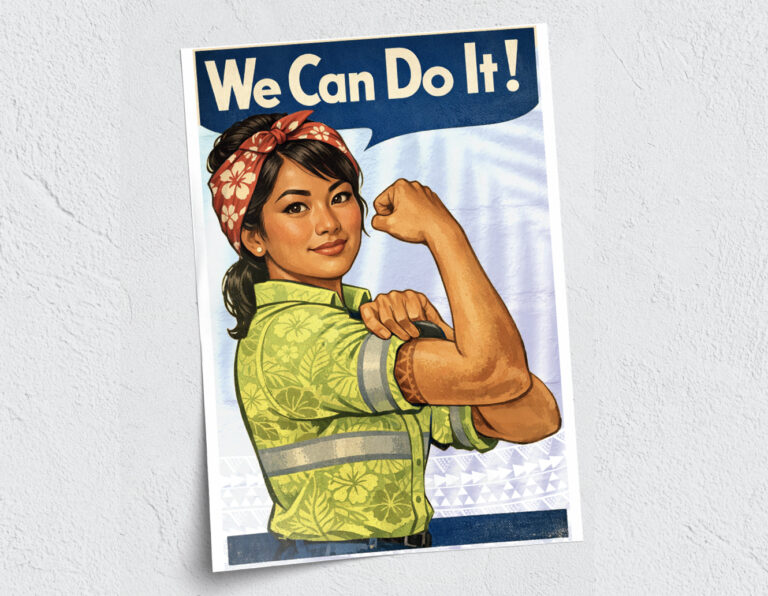
Most people in the Western World are familiar with the famous “Rosie the Riveter” image. The illustration was said to be inspired by its namesake song released in 1942:
“All the day long, whether rain or shine
She’s a part of the assembly line
She’s making history, working for victory
Rosie, the riveter
Keeps a sharp lookout for sabotage
Sitting up there on the fuselage
That little frail can do more than a male can do
Rosie, the riveter”
Although other versions existed at the time, J. Howard Miller’s poster featuring a woman flexing her muscles with the phrase “We Can Do It!” in bold letterhead became the most famous depiction of “Rosies.” Despite being initially unconnected to the song, the poster eventually became synonymous with “Rosie the Riveter.”
It represented the women who stepped into traditionally male positions in factories, shipyards and skilled labor roles during World War II, becoming a symbol of the strength and resilience of women for generations and remaining an icon to this day.
“Rosies” were real women who broke stereotypes and shattered gender barriers. They completed physical, technical and demanding labor in areas that had historically excluded most women.
After the war ended, the vast majority of these women went back to their previous roles, but the legacy and image of “Rosies” lived on. It embodied the unconventional pivot of women during those wartime years, a symbol of female empowerment and capability.
Ever since, young women have looked to that image as the representation of what’s possible. Regardless of generational differences, it stands the test of time as an emblem of the strength of womanhood.
The wāhine in this article are part of the current movement of women who challenge convention.
From seasoned professionals to newcomers, these women are hands-on in the construction field. They’re onsite installing, mapping, learning and mentoring. They’ve shared with us some of their experiences and passed on advice.
Most importantly, these women remind us that representation matters. Inclusivity and the visibility of women throughout the industry encourages younger women to pursue roles that may have previously seemed unattainable.
These women are not only trailblazers, they’re also passionate individuals whose unique skillsets and backgrounds contribute to their respective disciplines.
JOCELYN CONOLY
Lead Carpenter, SageWater
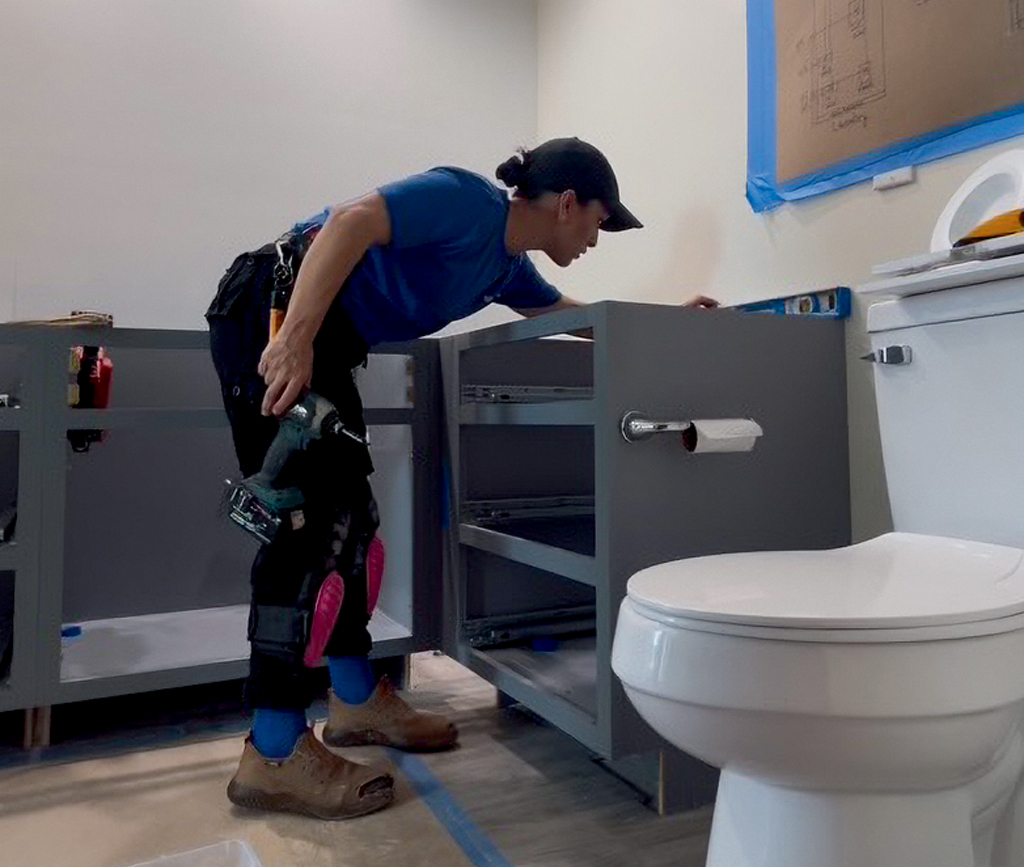
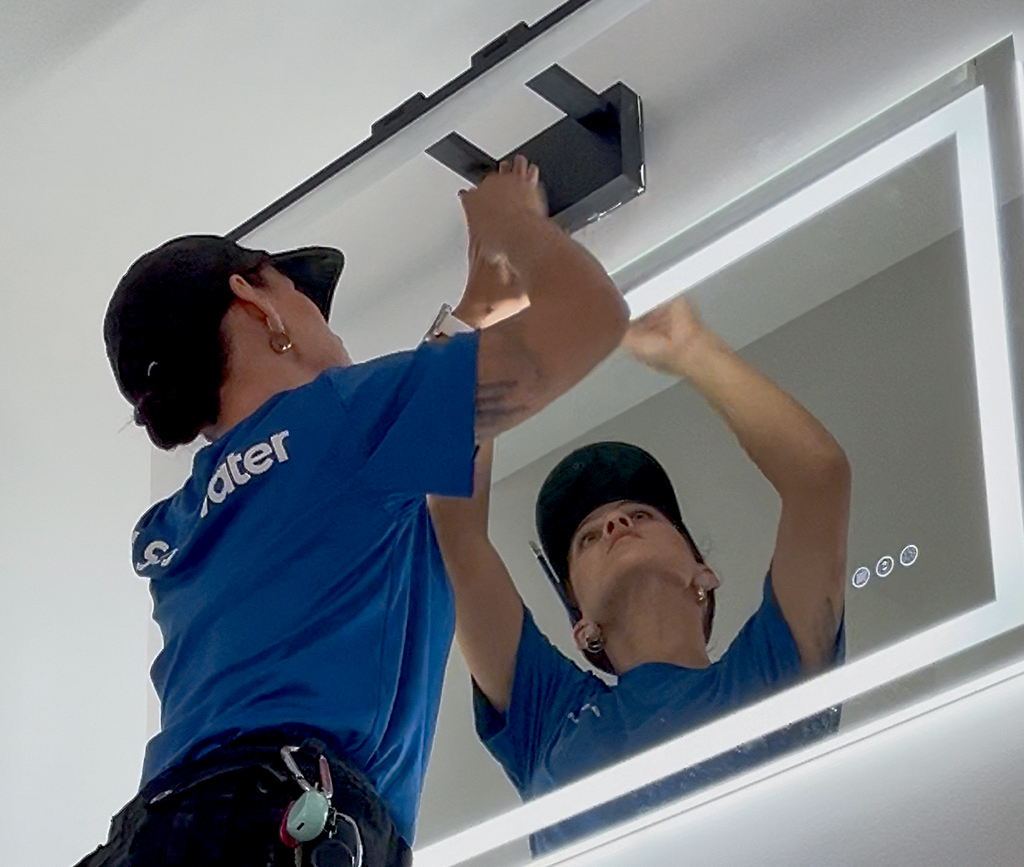
Jocelyn Conoly, SageWater’s lead carpenter, had an unconventional introduction to the trades, taking it upon herself to pursue the path of carpentry. Her ambition led to a rewarding and notable career, culminating in her current role as SageWater’s lead carpenter.
She became the definition of a self-made woman, forging her own path through sheer grit and determination to provide for her family as a young single mother.
As a tour guide on the U.S.S. Missouri, she took the initiative by assisting the engineering department, starting with menial tasks. “I often volunteered to help haul tools, wrap up extension cords and clean up at the end of the day,” recalls Conoly.
Her initiative eventually paid off: An opening in the ship’s engineering department became Conoly’s first step into her new career in the trades, where she received on-the-job training.
“My first experience in carpentry was installing teak decks, building and repairing nautical furniture and various other tasks as a boat carpenter,” says Conoly.
“When I decided to get into the trade, I knew that I had two major obstacles to overcome: my lack of knowledge [and] experience and my strength,” she says.
Conoly took charge of her on-site education, asking questions and researching on her own. She found a way to play into her strengths rather than seeing natural physical differences as a setback.
“I kept a consistent, energetic pace throughout the day,” says Conoly. “… I always found ways to tighten up my performance as well as increase my speed.”
What she may have initially lacked in physical strength, she made up for in efficiency.
“As a finish carpenter, we are defined by skill level, attention to detail and quality of work,” Conoly explains. “Strength isn’t as important as endurance and skill.”
Conoly didn’t have any women mentors throughout the beginning of her career, so she is stepping into that role herself for the next generation.
“I’m grateful to have grown into a woman that other ‘tradey-ladies’ can look up to. I am currently mentoring another woman who is now my apprentice,” says Conoly.
“I would like to see more women in the trades. We have seen an increase within the [last] few years, but I think we can do better,” says Conoly. “I think women need more of a ‘sisterhood’ style mentorship where [they] can be better-mentored on how to navigate through a male-dominated industry.”
Conoly’s career exemplifies the internal drive that many women in construction — especially the trades — must have to succeed.
“I want other women to know that they really are capable of doing anything,” says Conoly. “Make sure you educate yourself in whatever trade you are interested in and then go for it. Anything can be learned.”
ALEIHA WAYMAN
Quality, Commissioning and Warranty Regional Manager, Moss
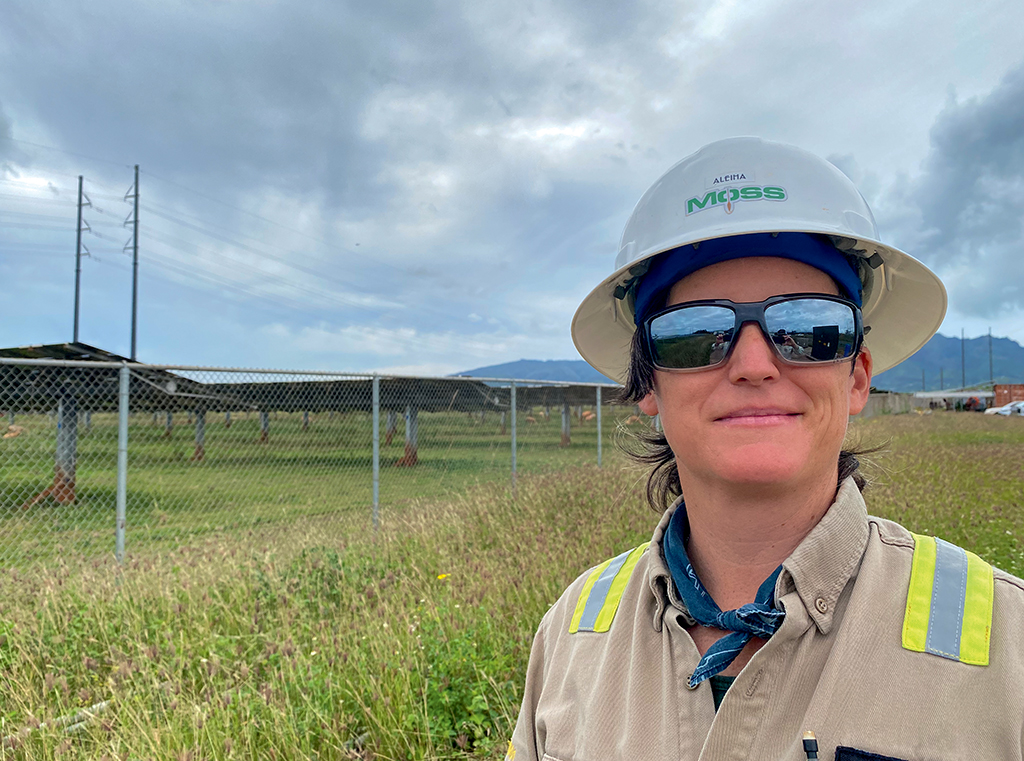
Aleiha Wayman’s nearly 20 years in the industry have developed into both a lucrative career and a lifelong calling and passion for renewable energy.
“The same spark that ignited my interest in renewable energy almost 20 years ago is still burning,” says Wayman. “Reducing reliance on non-renewable fossil fuels, producing clean, renewable energy locally and lowering energy costs for our communities has always inspired me to keep working each day.”
Her enthusiasm for solar energy began in college after a renewable energy course motivated her to get a bachelor’s degree in natural resources and sciences, but earlier inspiration for the trades stemmed from her father.
“During his life, he was a fisherman, carpenter, mechanic and calibration engineer and could build and fix just about anything,” says Wayman. “He would coach me through small projects and fostered my confidence and desire to work with my hands.”
Wayman says her father’s unwavering support in any career path she might choose had only one caveat, that she “be the best at whatever it was.” That early foundation translated into a constant source of inspiration to improve in her trade.
“Those words have driven me to excel in all that I do and appropriately led me to a quality control managerial position,” says Wayman.
Wayman says that early in her career, there was a lack of representation among women in the workforce, particularly in the field. Despite her passion and motivation, being the only woman on the field presented its challenges.
“It was definitely difficult being the only young woman on a construction site in the beginning, especially large sites where folks are trying to stand out and move up,” says Wayman. “Consistency and reliability became my path to success, as well as my willingness to go above and beyond to finish projects.”
As a result of those early experiences, she and some friends formed an unofficial group of tradeswomen who would come together for support, advice or just to lend an ear.
“It’s encouraging to see more women stepping into a wide range of roles … Personally, I’ve made it a priority to seek out and support talented women to join my team, and I’ll continue to do so,” says Wayman.
Wayman spent the first 13 years of her career as a solar installer. She made her way up through the ranks from foreman to project manager and ultimately into the safety, quality and commissioning manager position.
After more than a decade working at REC Solar, she made the jump to Moss in 2021 where she has served as quality, commissioning and warranty regional manager ever since.
“My biggest fear was starting over at a new company and having to prove myself all over again,” says Wayman.
After reassurance from a friend that “[her] reputation and work history speaks for itself,” she took the position and says it has paid off immensely.
“Don’t be afraid to take those leaps and don’t get discouraged if things don’t go your way,” says Wayman. “Persistence and performance will eventually pay off.”
“I hope this inspires other young women to chase their dreams,” says Wayman. “Construction isn’t just for the boys anymore.”
MIKA HONGO
Integrated Construction Technology Specialist,
Nordic PCL Construction Inc.
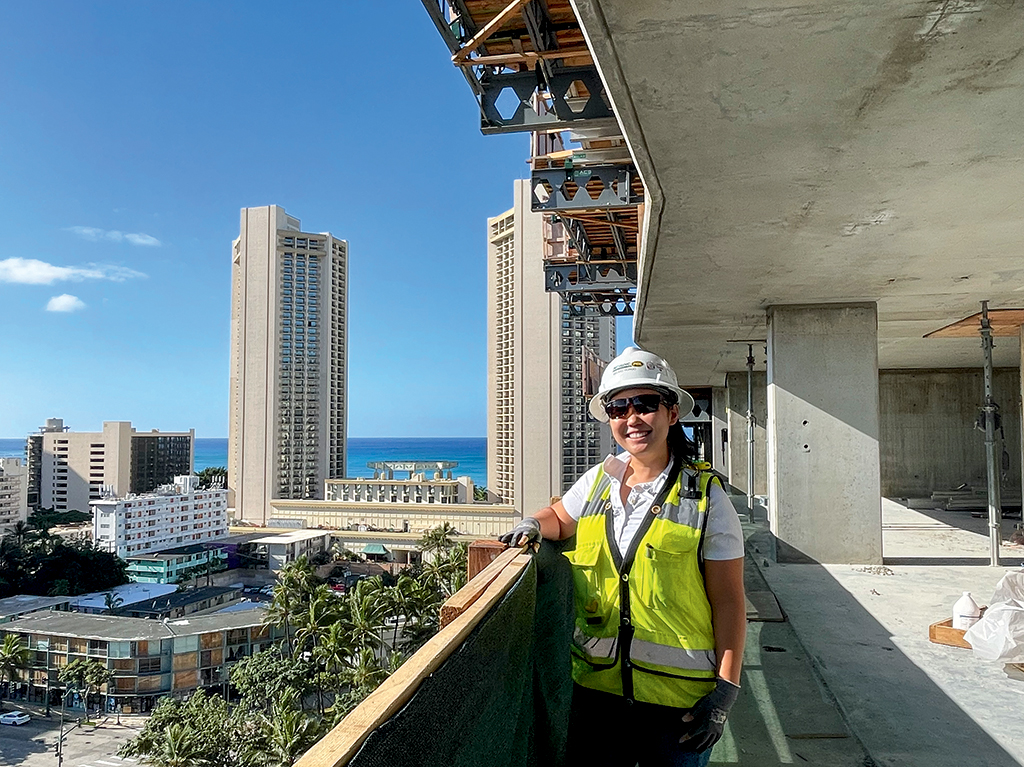
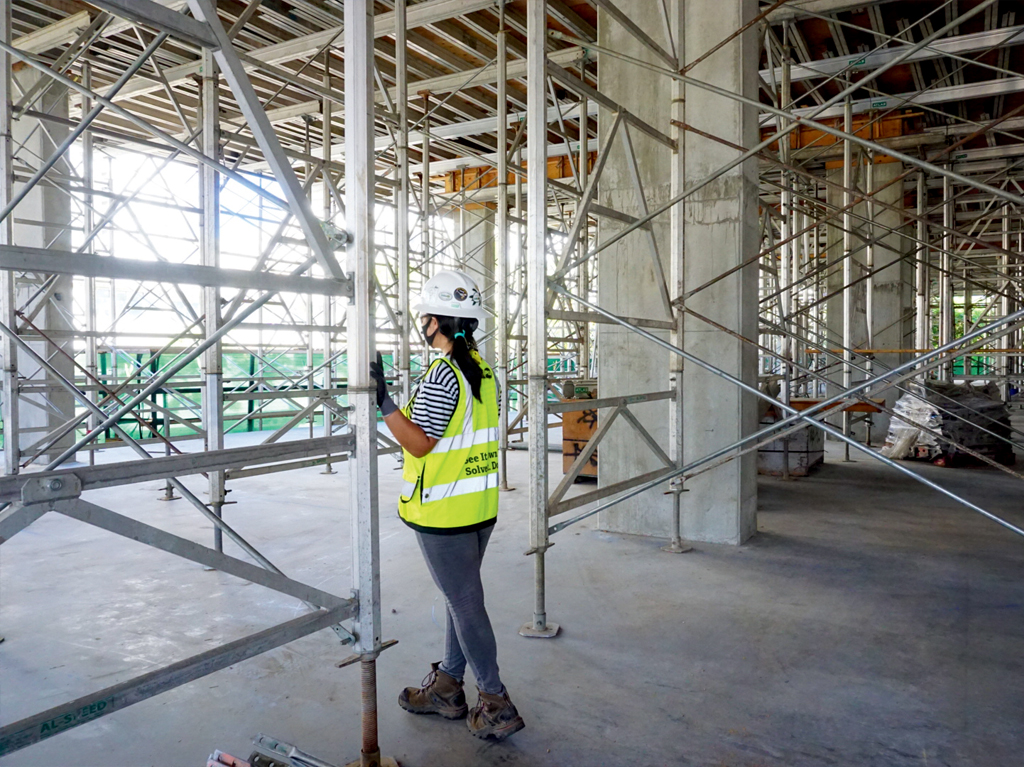
Integrated Construction Technology (ICT) Specialist Mika Hongo’s discipline lies where construction and technology intersect.
Gaining a degree in civil engineering from the University of Southern California, Hongo says she always expected her career to be construction-adjacent.
“Altogether, my role allows me to bridge technology and construction in a meaningful way, contributing to both the planning and execution phases of our projects.”
But being an ICT specialist doesn’t mean Hongo is stuck behind the computer all the time; she can often be seen on-site assisting with 3D scanning and drone operations.
She says one of her early mentors in her first job helped her “understand how things worked in the real world, not just on screen.”
“Watching something I modeled or coordinated virtually take shape on-site is one of the most fulfilling parts of my job,” says Hongo. “… [N]othing compares to seeing the final product — knowing it represents everyone’s dedication, collaboration and perseverance.”
As a child she says she was “drawn to building and problem-solving,” an interest that her mother encouraged which was instrumental in developing her career.
Similar to construction, women in STEM (Science, Technology, Engineering and Math) are also underrepresented in the workforce. Hongo says she “believe[s] meaningful change begins with breaking down early gender stereotypes.”
“To expand opportunities for women, industries need to nurture young girls’ curiosity and creativity, provide hands-on experiences and ensure they have visible role models in technical fields,” says Hongo.
Throughout both her career and education, Hongo says having female peers, mentors and professors was “incredibly encouraging.”
“That representation made a real difference — it helped normalize women’s presence … and reinforced that these careers are open to everyone,” says Hongo.
“When women see others like themselves thriving as leaders and experts, it breaks down stereotypes and opens doors for the generations that follow.”
Hongo says she has been lucky to avoid any negative encounters or stereotypes in her career thus far, even despite it being a male-dominated industry, but that she’s aware of the “unspoken challenges” it often presents.
There is often a “subtle pressure to prove yourself,” says Hongo.
“I navigate these moments by staying confident in my knowledge and the quality of my work,” says Hongo. “Over time, I’ve learned that when people see your competence, consistency and willingness to collaborate, respect follows naturally.”
For young women thinking of entering the industry, Hongo says to “stay curious and keep learning … adaptability will set you apart.”
“Build your network, advocate for yourself and trust your abilities, even if you’re the only woman in the room,” Hongo says. “Your perspective and skills are valuable, and they bring meaningful strength to any team.”
The up-and-coming
generation of tradeswomen
According to Construction Coverage’s 2025 report — which studies U.S. consensus data — only 13.4 percent of Hawai‘i’s construction workforce is made up of women.
Although Hawai‘i is slightly higher than the national average, the vast majority of the roles women take on are in office and administration, sales, management and finance. The study states that nationwide, “only 4.5 percent of transportation positions and 4.1 percent of construction and extraction roles are filled by women. Representation is even lower in maintenance and repair jobs, as well as production roles, where women account for just 2.0 percent and 3.5 percent of workers, respectively.”
Local companies have invested in training and education development programs, and many are specifically aiming to recruit young women, like Hō‘akeolapono Trades Academy & Institute’s Nā Wāhine program.
“Industry-wide, there’s definitely more momentum behind inclusivity efforts,” says Moss’ Aleiha Wayman.
The following two apprentices are nearly finished with their respective programs. Their experiences show that inclusivity matters and that when young women have encouraging and supportive mentors, they can rise despite their obstacles.
KYA DORATI
Apprentice, American Electric – International Brotherhood of Electrical Workers
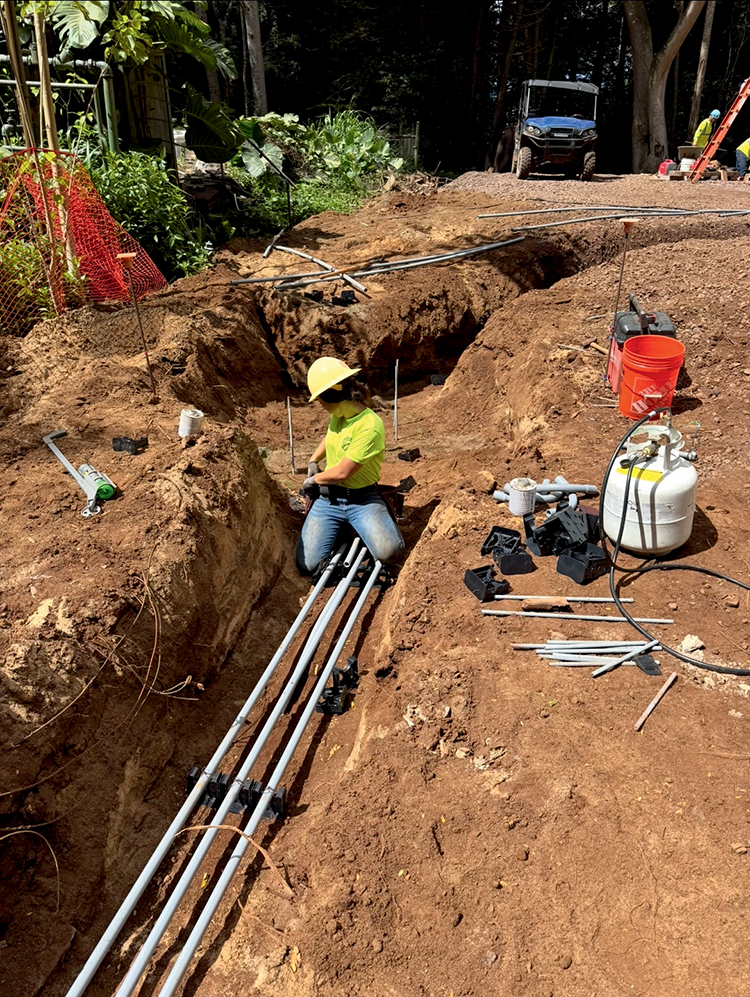
One of American Electric Apprentice Kya Dorati’s early role models was her uncle, who worked in the trades.
“Growing up I didn’t have a lot of successful influences in my life, except for him. He was the guy everybody called when they needed help,” says Dorati. “… I basically wanted the same for myself. To be someone people could rely on and to be financially set to live a stable life, as well as give back.”
Dorati followed in his footsteps by entering the Hō‘akeolapono Trades Academy & Institute (Hō‘akeolapono) and then starting an apprenticeship at American Electric as part of the IBEW 1186 Union.
Dorati says the wāhine classes at Hō‘akeolapono were incredibly beneficial not only as a learning experience, but also as a confidence boost.
“Learning something male-dominated can seem kinda scary, but when you’re surrounded by women, being taught by [women] … [that] makes it not scary, but encouraging,” says Dorati.
“… [C]onstruction is a very dangerous job, it’s a very dirty job and a very tiring job,” says Dorati. “So as much as it’s not for most guys, it’s not for most women either.”
But that didn’t stop her. One lesson Dorati says her apprenticeship has taught her is to not avoid challenges or tasks you don’t automatically excel at.
“Only doing work that comes easy to you prevents you from growing in areas that you lack,” says Dorati. “[B]eing well- rounded makes you more valuable to a company and opens more doors of opportunity.”
She credits Kelcie Yomen, instructor at Hō‘akeolapono and developer of the Nā Wāhine program, as one of her major influences and role models in the industry.
During Dorati’s time at Hō‘akeolapono she says Yomen was “a great teacher, very patient and enthusiastic” who made every woman in the program “feel very confident and empowered.”
“Going into my apprenticeship with the IBEW she took me to Home Depot and gave me insight on every tool an electrician could possibly use,” says Dorati. “The world needs more Kelcie Yomens!”
SYDNEY PATANAPAIBOON
Apprentice, Hawaii Carpenters Apprenticeship & Training Fund – Hawaii Regional Council of Carpenters
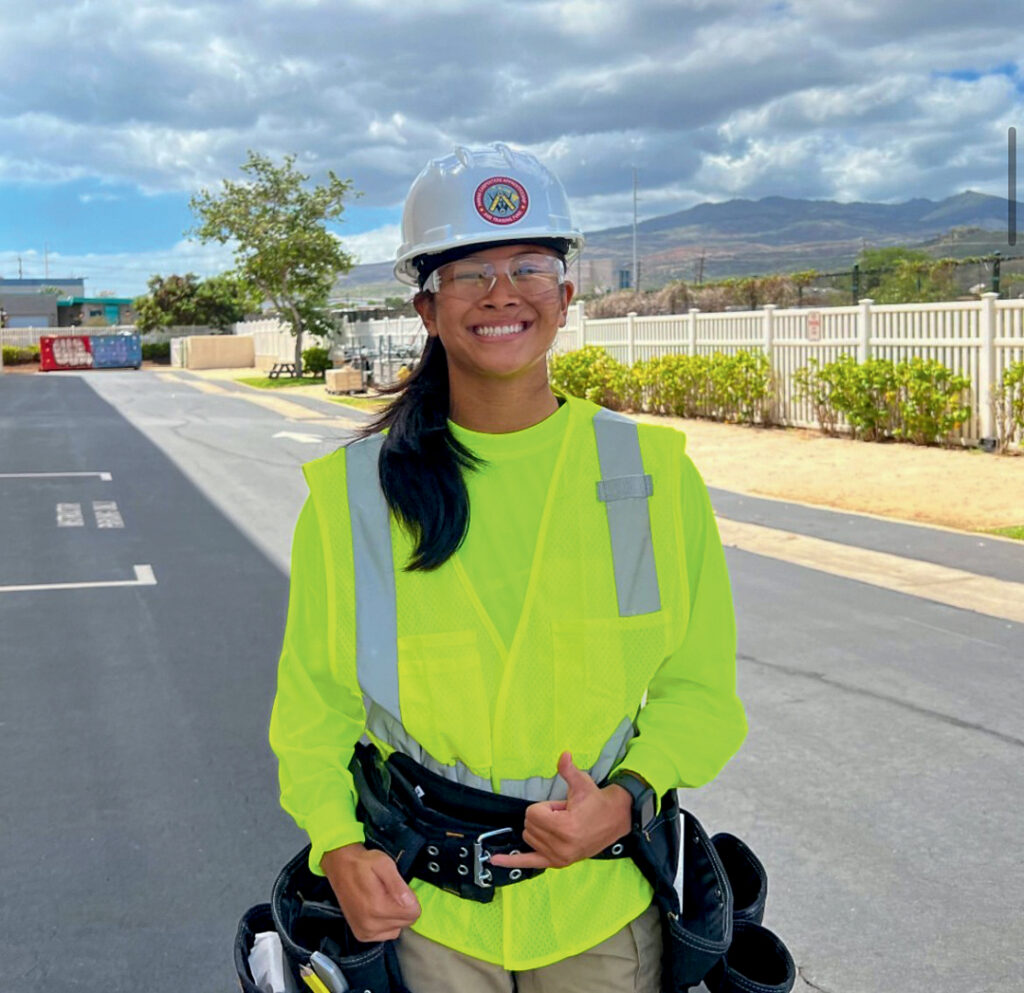
Fourth-year Hawaii Carpenters Apprenticeship & Training Fund (HCATF) Apprentice Sydney Patanapaiboon is in the final year of her apprenticeship, and is always eager to learn and put that knowledge to the test.
An interest in working with her hands along with a nudge of encouragement from her high-school shop teacher convinced her to apply for the HCATF summer apprenticeship in 2022 which turned into joining the full-time program shortly thereafter.
Early on in her apprenticeship Patanapaiboon experienced unwelcome conduct which she says made her second-guess her decision in joining the program.
“I was on the verge of dropping out, but the support I received from the internship coordinator changed everything,” says Patanapaiboon. “They took my concerns seriously, handled the situation appropriately and most importantly offered words of encouragement that reminded me of my worth and potential. Without that conversation and support, I truly believe I would not be in the program today.”
Despite the initial challenges, Patanapaiboon has come to thrive in her new role.
“The best advice I’ve received from a mentor is to prioritize communication — with myself and with those around me,” says Patanapaiboon. “Taking the time to ask questions, speak up and reflect internally has helped me gain clarity and confidence in my work.”
Patanapaiboon says that through “preparation, planning and communication” she’s learned to get things right the first time. She says “patience and foresight” are two key principles engrained into her through her training.
Patanapaiboon isn’t only passionate about her future career in carpentry, she’s also passionate about matters affecting unions and other industry organizations.
“… These decisions directly affect our livelihoods,” says Patanapaiboon. “Staying informed and engaged gives us a voice and an opportunity to have a real say in the direction of our work and our futures.”
“Looking ahead, I am eager for the many future projects I will be a part of and for the opportunity to contribute to building and strengthening Hawai‘i for years to come.”
What’s New with NAWIC and PWB
Industry organizations support women in construction
through education and service
Leaders of the National Association of Women in Construction (NAWIC) Hawaii Chapter and the Professional Women in Building (PWB) Hawai‘i Council are looking forward to cultivating statewide relationships and opportunities in 2026.

Rellen Resuello, NAWIC Hawaii president, says the organization is focused on “expanding our presence statewide through meaningful community outreach and strong partnerships with industry collaborators.” The organization’s fiscal year started with a service initiative supporting the nonprofit Ma‘i Movement with menstrual care kits and bringing representatives from 16 local “wāhine-focused groups” together at a NAWIC Hawaii membership meeting to explore potential areas of collaboration.
“This gathering reflects our ongoing commitment to elevate women in construction and create impactful connections throughout Hawai‘i,” Resuello says.
Women in Construction (WIC) Week — held annually during the first full week of March — is NAWIC Hawaii’s cornerstone celebration. Resuello says WIC Week 2026 continues a tradition of networking and site visits that underscore “the importance of diversity, equity and opportunity in shaping the future of construction.”
PWB also advocates for more representation of women in construction and the trades. Operating under the Building Industry Association Hawaii, PWB marks steady growth in memberships and events since the Hawai‘i council was established in 2024.

“Through collaboration with other women-led organizations, PWB aims to strengthen the construction workforce by joining forces, supporting one another’s initiatives and expanding opportunities for women in the industry,” says Tiffanie Gardner, PWB chair.
Gardner reports new PWB training, service and fundraising initiatives on the horizon. Education Committee members are organizing a general contractor licensing preparation program and sessions on integrating artificial intelligence in project management. The Outreach Committee is working closely with Habitat for Humanity Leeward and the Dress for Success program at YWCA O‘ahu. On the social side, a pickleball tournament fundraiser is slated for early May.
For more information on NAWIC Hawaii and PWB membership and events, visit nawichawaii.org and biahawaii.org/pwbhawaii.