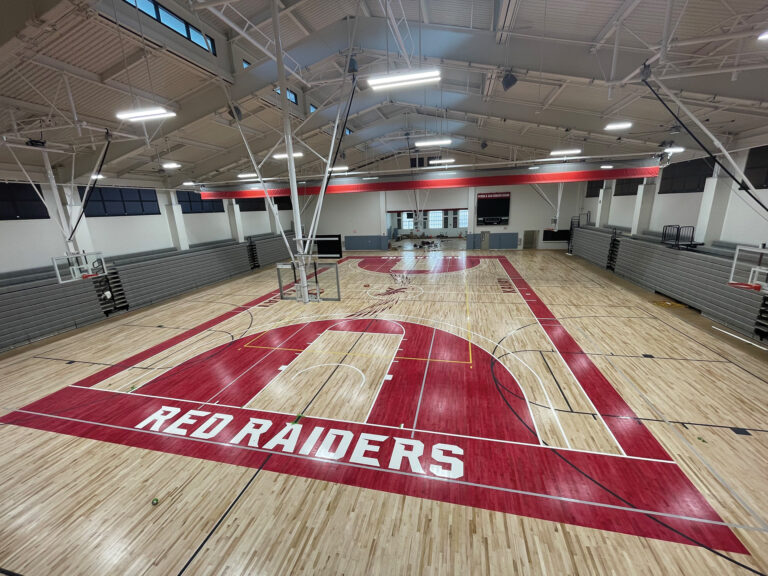
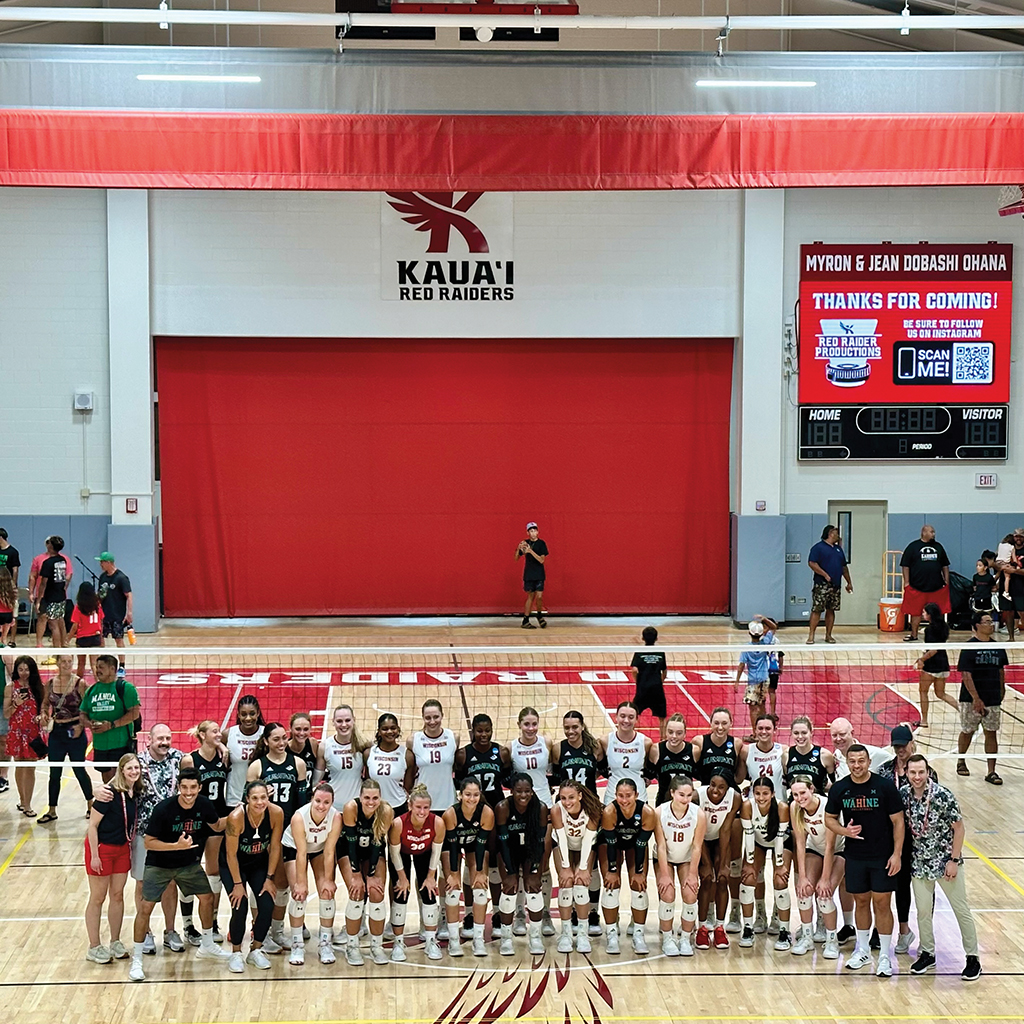
That community connection the gym provides does not end there. “It’s quickly becoming a valuable asset to the broader community. We’ve hosted events such as a youth volleyball clinic and [Division 1A] NCAA (National Collegiate Athletic Association) match featuring the University of Hawai‘i [Rainbow] Wāhine and Wisconsin Badgers — an incredible experience for local fans and young athletes alike,” Morgado explains. “Additionally, we’ve welcomed two major youth basketball tournaments, bringing in teams from across the state and even the mainland. We intend to host annual preseason tournaments for basketball, volleyball and wrestling.”
These positive results were always intended to extend beyond the gym floor. “These events not only provide learning opportunities for youth but also strengthen our community’s connection to the school,” Morgado adds.
For a school with an enrollment of just over 1000 students, a tiny fraction of 165,340 HIDOE students statewide in the 2024-2025 school year, Kauai High School’s new gymnasium has become an established beacon of excellence much larger than its 1600-seat capacity.
BUILDING BIGGER AND BUSIER
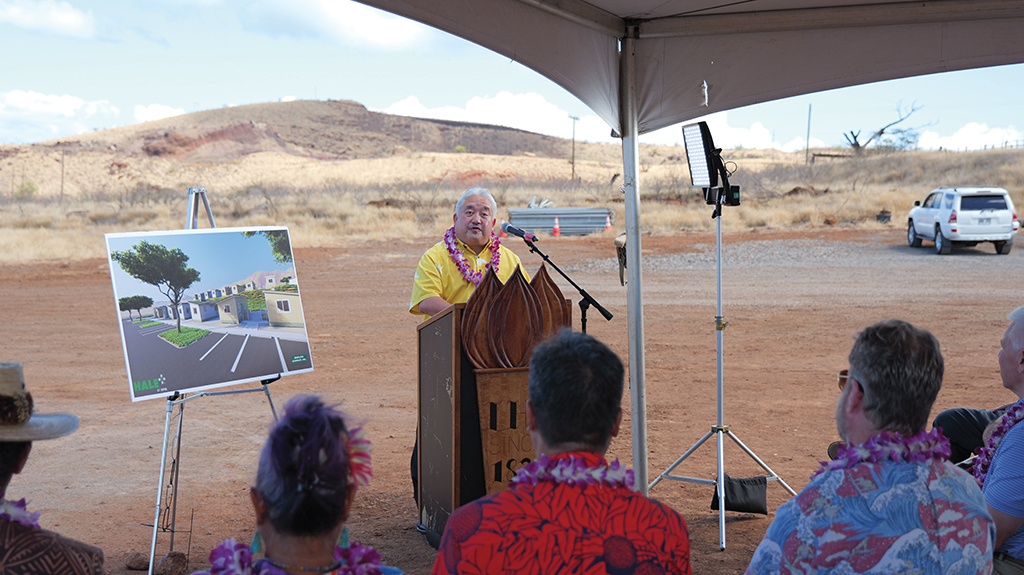
Ground was broken for a new gymnasium at Farrington High School on June 18, 2025. It is Phase II of a long-term plan at the school, and will include a new music education facility, locker rooms and additional physical education spaces. It is scheduled for completion in 2027.
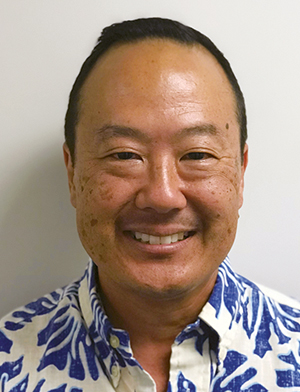
Mark Tagami
The ambitious $61-million project will certainly have an impact on the Kalihi community in the heart of Honolulu’s teeming urban corridor, even before the first concrete slab is poured. The construction logistics of a project in such a densely populated commercial, industrial and residential area are daunting and complicated.
Mark Tagami is vice president and chief operations officer at Ralph S. Inouye Co. Ltd. (RSI), the general contractor selected to lead the construction. “The safety of students, faculty and the neighboring area is the highest priority,” he says. “Limited space and busy traffic require planning for deliveries, staging and worker access. Additionally, noise and dust management are planned to avoid interfering with classroom activities. Communication with administrators and coordination with the academic calendar will be another key factor.”
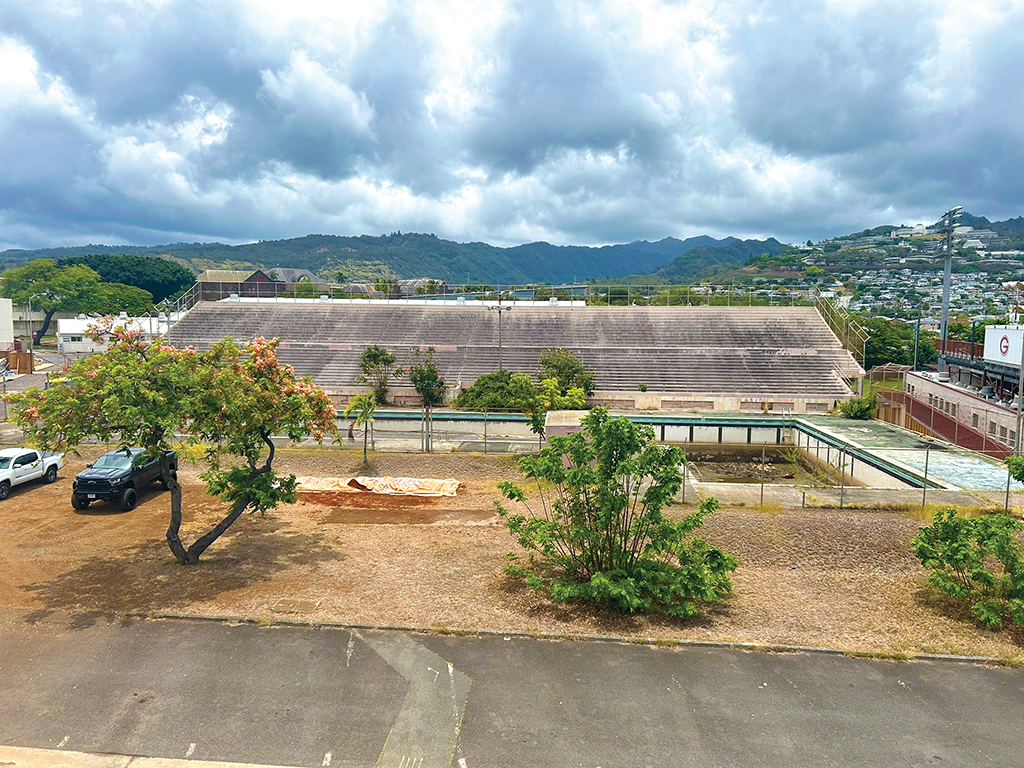
The construction of the new gymnasium at Farrington High School will be a part of the daily lives of Kalihi residents and workers for two years. Minimizing that impact on the community will be a challenge, one that the contractor is well-positioned to meet and exceed.
“RSI’s 60-year experience with [HIDOE] projects has equipped our team with the expertise necessary to meet the challenges of on-campus construction,” says Tagami. “From coordinating phased work schedules to managing communication with school administrators and stakeholders, we have developed best practices for working in occupied school environments. As the general contractor for Phase 1 campus improvements — which included the new [Edward “Skippa” Diaz] stadium, locker rooms and track and field — we’ve also gained a strong appreciation for the school’s culture and built a good relationship with its leadership. That experience gives us a valuable head start as we begin this next important phase.”
Thriving schools are a linchpin for thriving communities, and the improvements that the new Farrington High School gym and music facility will bring to students and their families are meant to improve the broader Kalihi community.
“Each phase of this long-term effort is about more than buildings,” said Hawai‘i public schools system Superintendent Keith Hayashi at the June groundbreaking. “[It’s about] creating opportunities and investing in our students’ futures. We’re grateful to our legislators, community leaders, businesses and proud Farrington alumni for helping make this vision a reality.”
Also on hand at the groundbreaking was Hawai‘i Lt. Gov. Sylvia Luke, who said, “When people at the state, county and businesses invest in this community, it sends a message to every child who’s going to Farrington that people care about you. And because of that,” she continued, “we expect the most from this community, the school and the students.”
The new gymnasium project at Farrington High School also allows an opportunity for the Kalihi school to showcase new construction methods, technologies and sustainability objectives.
Tagami explains: “We will use technologies, including 3D models and AI (artificial intelligence), and LEAN construction practices to boost efficiencies. The project is also being guided by the Hawai‘i-adapted HI-CHPS standards, which serve as a benchmark for designing and constructing high-performance educational facilities. This includes sustainable design strategies, environmentally responsible materials and methods, and conserving energy and water.”
EDUCATION CONSTRUCTION BEYOND CLASSROOMS
New schools and gymnasiums and other education construction uplift the communities they call home. So, too, does providing housing for educators, administrators and other school staff. The Lahaina Educator Workforce Housing project was conceived and designed to ease housing pressures on educators in the aftermath of the devastating Maui wildfires of 2023. The project broke ground in May 2025, with Dowling Company Inc. selected as the general contractor.
The project includes 47 rental units which will be prioritized for HIDOE educators at a time when Maui’s housing market continues to reel from the disastrous long-term effects of the wildfires.
“This project responds directly to that need — the need for housing our school employees,” said Maui Mayor Richard Bissen at the groundbreaking. “That will bring consistency to our classrooms that allows those who guide, who nourish, who transport and care for our students to remain close to the places they serve.”
It is an education construction project that addresses the housing crisis head-on, a direct approach to a challenge faced by the entire community beyond the classroom. Though small in scale, it can provide a model for similar projects across multiple industries throughout Hawai‘i.

Krystle Beauchamp
Krystle Beauchamp, construction manager at Dowling Company explains, “The Lahainaluna Complex project offers a promising model that could inform future workforce housing initiatives across Hawai‘i,” she says. “Its use of state-owned land to create housing for essential workers has broad applicability.
“While this project advanced under unique conditions that enabled it to move quickly,” Beauchamp continues, “it has sparked meaningful conversations about how similar targeted housing efforts can be replicated to support educators, healthcare workers and other vital sectors statewide. It’s not a one-size-fits-all solution, but it’s a strong example of what’s possible with the right collaboration and sense of urgency.”
The importance of fire safety and sustainability for new construction on Maui (and, indeed, everywhere in Hawai‘i) was brought into sharp relief by the wildfires of 2023. The Lahainaluna Complex housing development has responded with a strong focus on those priorities.
“The project incorporates various design and construction strategies to improve sustainability, energy performance and fire resilience,” says Beauchamp. “The exteriors of each unit are constructed with fiber-cement siding and standing-seam metal roofs — materials chosen for their durability and resistance to fire and moisture. Inside, each unit includes energy-efficient appliances and solar water heaters to help lower energy usage and utility costs. All these design choices were made to offer residents a safe, efficient and affordable place to call home.”
Having a place to call home is essential for Hawai‘i’s educators, administrators and campus staff. The problem of “brain drain” in Hawai‘i, of residents leaving for more affordable housing opportunities abroad, has been discussed for decades. Currently, there are over 300 teacher vacancies in HIDOE, although vacancies have dropped significantly in the past three years.