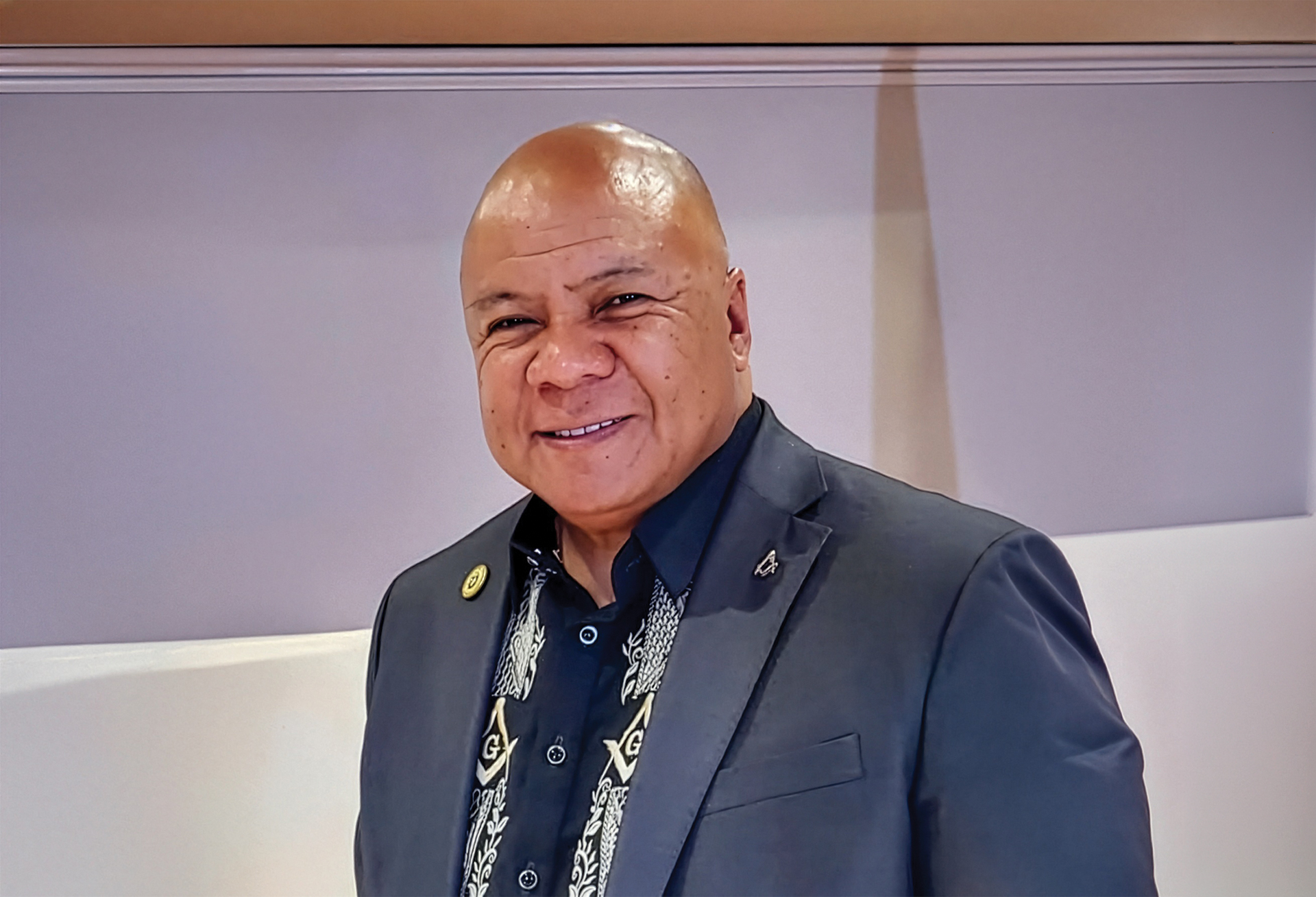

In November 2024, Nathaniel Kinney was announced as the new executive director at Pacific Resource Partnership, where he draws from both his professional and personal experiences to helm the organization that represents the Hawaiʻi Regional Council of Carpenters, Hawaiʻi’s largest construction union. While his responsibilities have him dealing with developers, politicians and other high-level movers and shakers, it was clear from our conversation that Kinney’s passions lie in addressing the down-to-earth concerns facing Hawaiʻi’s workforce and working families.
Question: When you were a kid, did you have a sense of what you wanted to be when you grew up?
Answer: I was consistently told that I should become an attorney because I was pretty argumentative. I went to UNLV and got a degree in U.S. history. And when you’re done with a degree in U.S. history, you can either become a teacher or you can become a professor or you can go into law school. So I went to law school, and I took a little break between school to go work at a union. And then went into law school, and then right as soon as I came out of law school, and even in law school, I was working for a union. Unionism’s been around for my entire life, though. My dad was in a union. There were two topics at the dinner table. It was the union and Vietnam, which is pretty heavy for a little kid growing up. But that’s literally what we always talked about. So working for unions has been kind of in the in the bloodline, I guess you could say.
Q: What’s a typical day look like for you now?
A: It’s meetings upon meetings. It’s a lot of meetings to prepare for events that we’re putting on or meetings to prepare for upcoming meetings, strategy sessions, alignment. It’s a lot of talking with the staff, talking with the union, talking with the contractors, talking with developers, talking with politicians. You’re kind of talking with a lot of the construction developing community and all facets of it, … not just the financiers, not just the politicians, but everything in between.
Q: So communication clearly is a huge part of your job.
A: Communication is, but it’s also like not just communication, but also bringing information in and distilling it down and then putting it back out again. Developer-speak is different than contractor-speak. I would say they talk two different languages; and then contractors and developers talk differently from politicians and regulators. They each have their own paradigm that they’re working with. But like PRP needs to be able to talk sensibly to everyone in the chain, even end users, landowners, all of those people in the chain, and be able to speak coherently to all of them and be able to make sense. And then also be able to take the information that we get from a developer and then take it to the contractor or take it to the government and be like, this is what they’re trying to say.
Q: What would you say are your biggest on-the-job challenges right now?
A: There’s a schizophrenia that I think is very apparent. Like we know we need more housing, but where do we put it? “Well, not over there, not over there, not over here, not definitely in my backyard,” right. And then we know we need better paying jobs. Like I’d say one with a living wage, with good benefits and a good retirement. And then people are like, “well, but I don’t want to pay that much.” So it’s like, OK, well, how are you going to pay for quality? You know what I mean? How are you going to get a good paying job if you’re not going to be willing to pay the going rate? So I would say that’s one of the issues that I see, especially here in Hawaiʻi because it’s … a very close-knit culture
Everybody kind of knows everybody. One of the things is there’s in Hawaiʻi that’s probably a little bit different is everybody wants to get along. So it’s really hard to get to a place where everybody is going to agree on everything. So … there’s another dichotomy. It’s like we all live so close together. We’re all so connected. It’s not three degrees of separation. It’s one degree of separation here in Hawaiʻi. And then how do you deal with that when we’re so close and when we’re so connected, like how do you get to 50 percent plus one, or even 60 percent? Because people don’t want that. People want 100 percent.
Q: You talk about this “schizophrenia” and conflicting needs and wants. Do you see a solution? What are your thoughts on how to bridge that gap?
A: The answer is more communication. You know, that’s what a politician would say, “We need to talk more.” And I think what the executive director of PRP would say is “we need to get some stuff done.” We cannot wait until everybody is going to agree before we need to tackle the serious issues that are in front of us like housing, like infrastructure, like climate change, like living wages. If we’re just going to sit here and wait till everybody agrees on that, we’re not going to make any progress. And this organization is about progress. It’s about moving in a direction. And having no direction but a lot of communication is useless. So I think we need to, we need to look at assembling a broad coalition, a majority, and then moving on.
Q: So with that said, there’s a sort of perfect storm of converging factors, with the tariffs, or the threat of tariffs; federal funding cuts, which will inevitably affect local construction; the workforce shortage. So what do you see PRP’s role to be in these times and how does the organization navigate these issues?
A: I look at them as near-term threats, but the long-term consequences are still the same. You know what I mean? Like there’s still going to be federal spending in Hawaiʻi. We still need to build homes. So tariffs, you know, [materials] are going to be more expensive, but we have to build more homes — we have a critical housing shortage.
As far as the worker shortage, as a society. I don’t think we’ve done enough to honor what blue collar workers do. We’ve disincentivized and kind of looked down upon these blue collar workers. As a society, we need to recognize what blue collars, especially the trades, do for us. And, and that’s something that we need to seriously address.
Q: So what would you say is the best professional advice you’ve been given?
A: This is the nice way to say it, but don’t confuse activity with progress. You can be getting dusty, you can be getting dirty, you can be out of breath. That’s not progress, that’s just activity. The results really speak for themselves. What did you produce at the end of the day? That’s the important thing
Q: What would you say your strengths are and what areas do you want to improve in?
A: I understand how to advocate — that’s part of being a lawyer, that’s part of being a union person. You know, you’re an advocate.
I think I need to brush up on more of my soft skills like marketing. You know, like sometimes when you’re advocating, you’re trying to, you’re kind of it’s a hard sell. “This is why you got to do it. Here are 10 reasons why it’s a good bill to pass,” or “This is why we need this project to go, because we need more housing projects in the pipeline.” And then marketing and, and these other soft skills, you’re not as much in somebody’s face as you’re kind of like letting them come to you a little bit. And I think that there’s, there’s a portion of that. I think that’s important is that we need to be presenting things about the unionized construction industry that have been taken for granted. And I think people need to see that.
Q: What is your go to plate lunch?
A: There’s a place, Howard’s. It’s like a mom-and-pop place, right in downtown. And I love their chili frank plate. They sell out though. You got to go down early in the morning and reserve it when they get there, like at like 8 or 9 because it’s gone by 11.